Best All-in-One Podcast Tools by Step (2026, Reviewed)

If you make a podcast on your own, every episode means the same chain of jobs in different tabs: record the guest, clean the audio, edit, write the show notes, cut a few clips, publish. "All-in-one" tools promise to collapse that chain, but no single tool is the best at every step. Riverside is the one for recording remote guests. Descript is the one for editing by text. Alitu takes a beginner from recording to hosting on one plan. Podsqueeze and Castmagic take over after the recording, from transcript and show notes to clips. Async, which Podcastle now redirects to, covers recording and cleanup for less.
Last updated 16 Nov 2026. Prices checked 15 Nov 2026.
TL;DR
- To record remote guests, Riverside. It has no free plan now, only a 14-day trial.
- To edit by text, Descript, from $16 a month billed annually, with an eye on the AI credits.
- To get from recording to hosting on one plan as a beginner, Alitu at $32 a month billed annually ($38 monthly).
- To get transcript, show notes and clips from one upload after you've recorded, Podsqueeze, with a free plan of 30 minutes a month.
- To run a library of recordings for clients, Castmagic, from $19 a month billed annually.
Why these tools
These are the established names in podcast production, and each leads at a different step. Between them they cover the path from recording to publishing, so most podcasters won't need a seventh tool.
- Riverside shows 4.8 out of 5 on G2 from more than 1,200 reviews, and its site lists customers and shows such as Spotify, Microsoft, The New York Times, Jordan Harbinger, The Official Marvel Podcast and Tim Ferriss.
- Descript has 4.6 out of 5 on G2 from 936 reviews, and its site says teams at Amazon, Canva and Salesforce use it, with Spotify, Vox and Reuters among the logos.
- Alitu, from The Podcast Host, holds 4.9 out of 5 on Trustpilot from 111 reviews.
- Async (formerly Podcastle) has 4.7 out of 5 on G2 from 187 reviews.
- Castmagic says more than 100,000 podcasters and creators use it, and its site shows HubSpot, Yahoo Sports and Wistia among its customers.
- Podsqueeze says it is used by 70,000 content creators and podcast professionals.
What we judge them on
Five things decide whether an all-in-one is worth it for a podcaster. Does it record guests reliably, or does it depend on their connection? How fast is the edit? Is the monthly cost predictable, or does it run on credits and limits you can't see until you hit them? Does it produce the written side (transcript, show notes, chapters)? And what happens at renewal, because billing surprises are the most repeated complaint across this whole category.
The case we'll use
A weekly interview, 45 minutes, a guest in another country, one person doing everything, published as audio and on YouTube. You want clean audio, show notes and three clips, and you have one evening. That is roughly 195 minutes of audio a month and one episode a week, and it is where the differences below stop being abstract.
The usual workflow
Most people end up with a stack rather than one tool. Record in a studio like Riverside, SquadCast or Zencastr (or in Zoom if they must), edit in Descript or a waveform editor, then upload the finished episode to a post-production tool for transcript, show notes and clips, and send it to a host. Two habits save more pain than any pick. Keep a local backup of every recording, whatever the platform. And put the renewal date of any annual plan in your calendar on the day you sign up.
| Step | Tools whose official pages list it (checked 15 Nov 2026) |
|---|---|
| Record | Riverside, Descript, Alitu, Async |
| Clean the audio | Alitu, Async, Descript, Podsqueeze (paid plans) |
| Edit | Descript, Alitu, Async |
| Transcript and show notes | Podsqueeze, Castmagic, Riverside, Alitu |
| Clips and posts | Podsqueeze, Riverside, Descript, Castmagic |
| Publish and host | Alitu (hosting up to 1,000 downloads a month), Riverside |
Riverside
Riverside is a recording studio first, and it added an AI editor, Magic Clips, transcription and show notes on top.
Each participant records locally in a separate track, so a weak connection on the guest's side doesn't wreck the file, and you can fix one voice without touching the other when someone coughs or talks over them. It runs in the browser and has Mac and mobile apps, and it publishes to YouTube, Spotify and Apple. Pro has a monthly cap of 15 hours of separate-track downloads.
The catch is long sessions. The complaints that recur are audio and video drifting out of sync, uploads that fail, and an editor that gets heavy on long projects. Magic Clips find the right topic but tend to cut at the wrong moment. It is also pricier than it looks: AI features such as translation, AI B-roll and Animated Clips spend credits (2,000 are included on Pro), and the free plan is gone. Against Descript, Riverside is the better recorder and the weaker editor, which is why many people record in one and edit in the other.
Riverside has many features, including a recording studio. If you need to record remote interviews, pick it. If you already have the episode and want the transcript, show notes and clips, Podsqueeze is much simpler to use, because there is nothing to set up before the first upload.
For our weekly show: Pro is $24 a month billed annually ($29 monthly) with a 14-day trial that asks for a card. It covers recording, transcription, show notes and clips, and it is the strongest of the six at the one step you can't redo.
Descript
Descript lets you edit audio and video by editing the transcript: delete a sentence and it disappears from the recording. It also records, transcribes and publishes, and its AI assistant, Underlord, comes with paid plans.
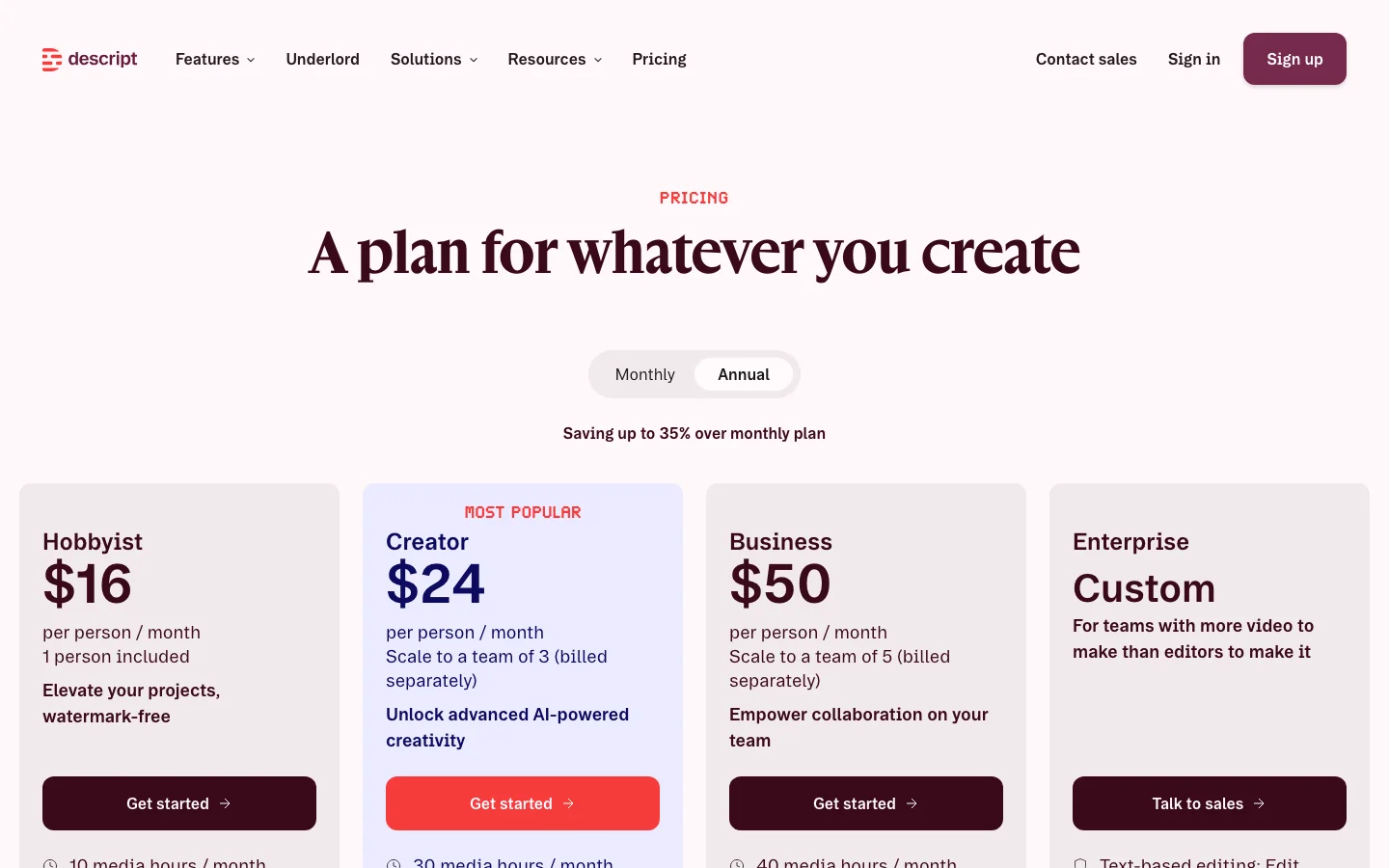 The Descript pricing page, checked 15 Nov 2026.
It publishes directly to Buzzsprout, Podbean, Captivate and Transistor and runs as a desktop app and in the browser, with no mobile app. Hobbyist includes 10 media hours and 400 AI credits a month, Creator 30 hours and 800 credits.
The catch is credits. Since the September 2025 pricing change, many AI features spend them, including the ones you use on every episode, like filler-word removal and silence trimming. Weekly shows are the ones who run out, so run the big AI passes once on the final cut rather than on every draft. The automatic cuts can also sound hard, so listen to each before you export, and save before rendering a long project, because long ones can crash. Against Riverside, Descript wins on editing and loses on recording. Against Alitu, it gives you far more control and a steeper learning curve.
For our weekly show: Hobbyist is $16 a month billed annually ($24 monthly), Creator $24 billed annually ($35 monthly). The free plan has 60 media minutes and 100 AI credits that don't renew, with a watermark on 720p exports. It is the best editing tool here, and for a finished episode that only needs a transcript and show notes, Podsqueeze gets you there faster.
Alitu
Alitu is a web app from The Podcast Host that records, cleans and levels the audio automatically, lets you edit by text or on the waveform, adds music, and publishes with hosting included.
Hosting is free up to 1,000 downloads a month and $10 a month up to 10,000. Transcription covers 12 hours a month in 17 languages, and the plan includes AI-written show notes and chapters. Video editing arrived in July 2026 and Social Clips in August 2026, so those are the youngest parts of the product.
The catch is control and price. The automatic mix leaves little to adjust, so people who care about EQ and compression move to an audio editor. Each show is its own subscription, so a second podcast doubles the bill, and distribution to Spotify and YouTube takes some manual steps. Against Descript it is simpler and less capable, and against Riverside it is a better single-plan deal for audio shows but weaker for video guests.
For our weekly show: one plan at $38 a month, or $32 billed annually, with a 7-day trial that processes up to 2 hours of audio (enough for one real episode, start to finish) and a 30-day money-back guarantee. It fits a new host who values having everything in one place over fine control.
Async (formerly Podcastle)
Podcastle became Async in early 2026, and its old address redirects. Async now presents itself as a broader AI platform, with video and image generation paid in credits, so look for the podcast tools inside it: remote recording with local tracks, Magic Dust audio cleanup, noise reduction, silence removal, text-based editing, subtitles and transcription.
Transcription covers five languages. The free plan has lifetime limits: 1 hour of multitrack recording, 2 hours of transcription, 15 minutes of AI clips, 720p and one exported file. That is enough to try one episode, not to run a show.
The catch is reliability and billing. Lost or out-of-sync recordings are the main complaint, which is the best argument for a local backup, and the trial can convert to an annual plan with a renewal people didn't see coming. Magic Dust works well in a home office or a car and less well in a bad room. Against Riverside it is cheaper and less proven for guests; against Alitu it has a free tier and a lower entry price.
For our weekly show: Essentials is €11.99 a month billed annually and Pro €23.99, in the Portugal price view. Good for recording and cleanup on a budget, and for the written side you'd pair it with Podsqueeze.
Castmagic
Castmagic turns recordings into a library of written content: summaries, timestamped overviews, show notes, articles, newsletters and social posts, with a chat for asking questions about a recording.
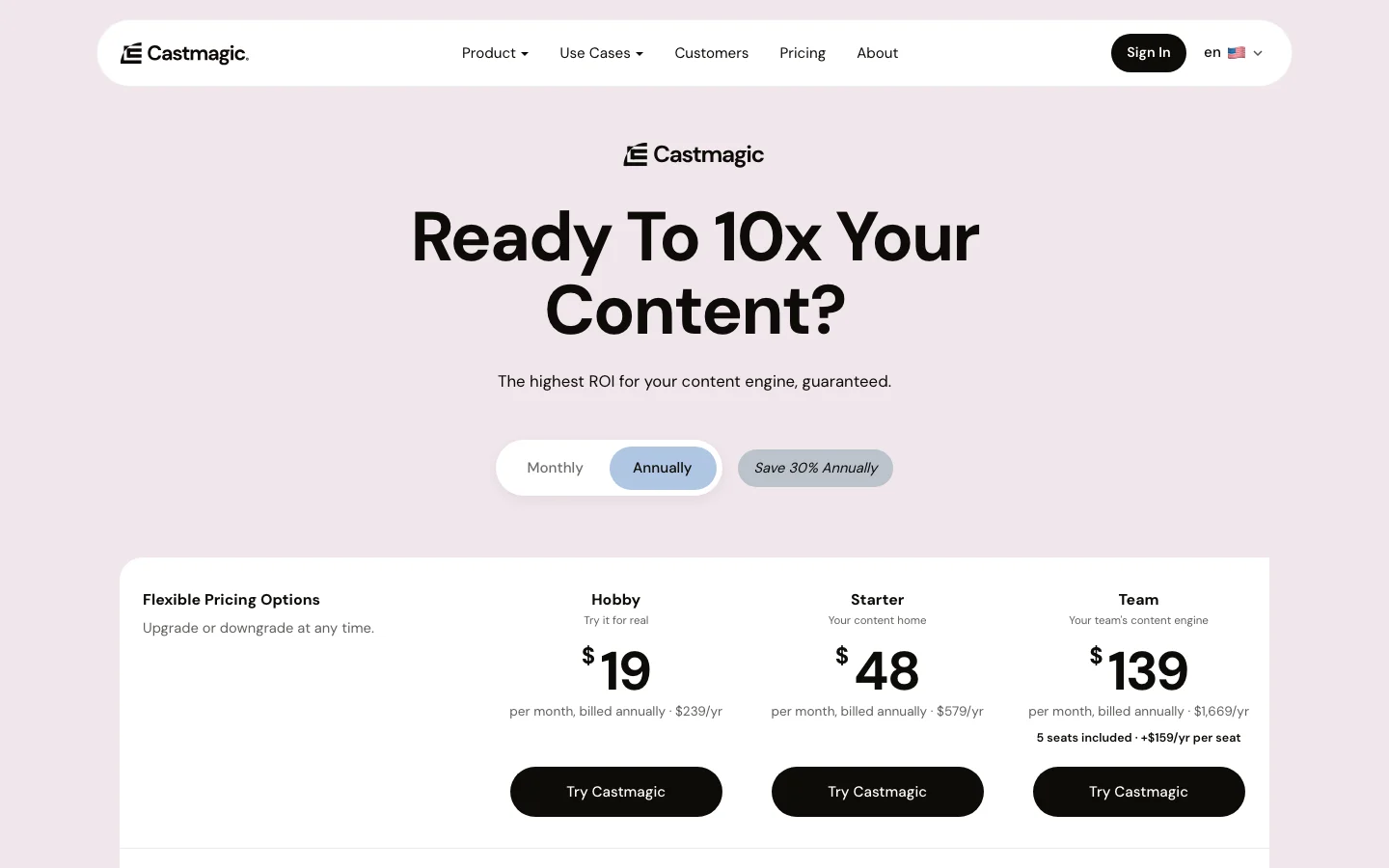 The Castmagic pricing page, checked 15 Nov 2026.
It takes uploads and imports from Zoom, Google Drive and RSS, transcribes in more than 60 languages and runs in the browser. The features people praise are the chat and the custom prompts.
The catch is what it doesn't do: it doesn't record, edit or enhance audio, it doesn't publish for you (you paste the show notes into your host), and YouTube link import has been unreliable, so plan on uploading the file. Skeptics say a chat assistant with a good prompt gets similar text, which is fair for a solo show. What you pay for is the library, saved prompts and workspaces. Against Podsqueeze it is built for teams, and Podsqueeze is simpler and cheaper for one show.
For our weekly show: Hobby is $19 a month billed annually ($29 monthly) with 30 hours counted as a library total, which is forty 45-minute episodes. Starter is $48 billed annually for 100 hours. There is no free plan.
Podsqueeze
Podsqueeze covers the post-production steps from one upload. You can upload a file or paste a YouTube link, a Spotify or Apple Podcasts episode link or an RSS feed, and it returns a transcript with speakers and timestamps, show notes with chapters, a blog post, a newsletter, social posts, quote images and short clips. Audio-only episodes get audiograms and video gets captioned clips.
 The Podsqueeze repurposing page, checked 15 Nov 2026.
Every plan includes episode landing pages and a podcast website, and paid plans include audio enhancement. It works with whatever you record in, Riverside, Descript or anything else, so you export the episode and upload it.
The catch is minutes, and it is the number to check. A weekly 45-minute show comes to about 195 minutes a month, so that's Pro, not Starter. The text is a first draft that needs a read for names and tone. And it doesn't record or edit, and runs only in the browser. Against Castmagic it is cheaper for one show and has less team machinery; against Descript and Riverside it does the written and clip side, not the recording or the edit.
For our weekly show: Free is 30 minutes a month and 10 clips. Starter is $5.99 a month billed annually ($8.99 monthly) with 120 minutes and 20 clips. Pro is $35 a month billed annually ($49 monthly) with 320 minutes and 40 clips, and keeps unused minutes for up to three times the allowance. The full list is on the pricing page.
What we'd pick
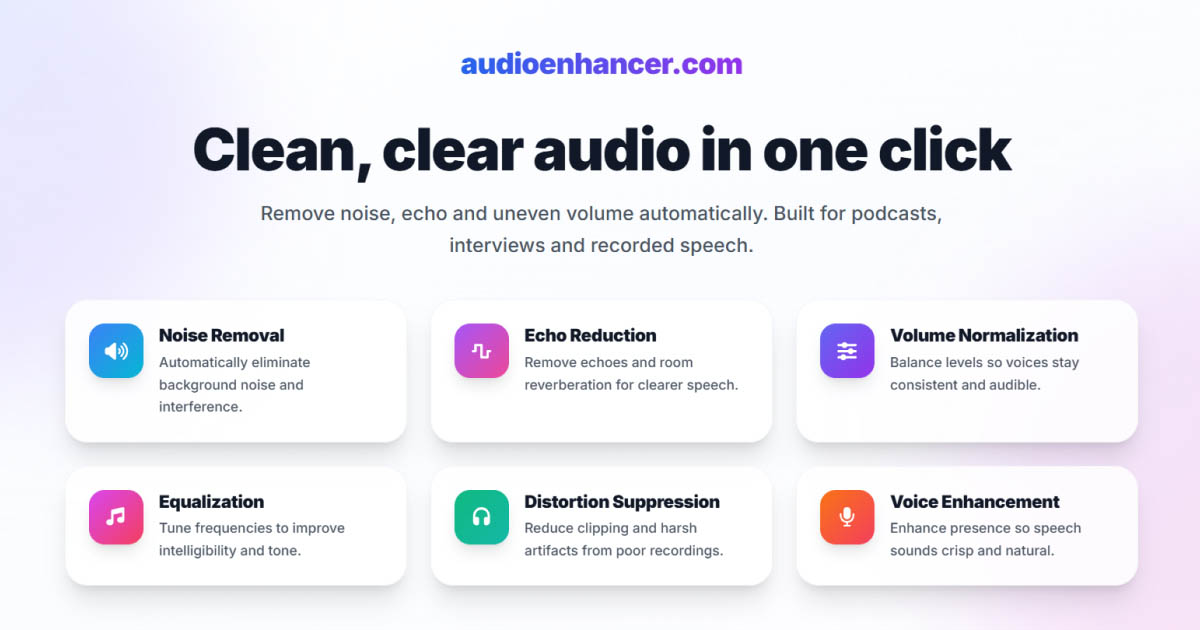
For the weekly show, we'd record in Riverside, edit in Descript only if the edit is slow, and upload the finished episode to Podsqueeze on Pro for the transcript, show notes and clips. If you're new and want one plan, Alitu. If the budget is tight, Async for recording and cleanup, plus Podsqueeze's free plan for the written side. If you run a library for clients, Castmagic. And clean the audio before it goes anywhere: a dedicated enhancer like AudioEnhancer.com fixes a noisy room, which recording and editing tools often don't. The guide to audio editing versus AI enhancers explains where each fits, and the guide to summarizing an episode with AI covers the written side in more detail. For the rest of the stack, see podcast enhancement tools beyond audio cleanup.
FAQ
Is there an all-in-one podcast tool with a free plan?
Podsqueeze has a free plan with 30 minutes a month, Descript has one with 60 media minutes, and Async has a free plan with lifetime limits. Alitu has a 7-day trial, and Riverside offers a 14-day trial on paid plans.
Can one tool record, edit, write show notes and make clips?
Several list a piece of every one of those steps, but none leads at all of them. Descript and Riverside list recording, editing and clip features, and Alitu lists recording, editing and AI show notes.
Do I need a separate tool for show notes?
If your recording or editing tool doesn't list show notes, yes. Podsqueeze and Castmagic are built for the written side, and Alitu and Riverside list show notes inside their own plans.
Which tool is cheapest to start with?
Podsqueeze Starter at $5.99 a month billed annually and Descript Hobbyist at $16 a month billed annually are the lowest paid entry prices among the tools with confirmed prices here, and they cover different steps. Podsqueeze also has a free plan.